Dear Skyline support team and Brendan,
I had a course in targeted proteomics in Zurich last jun. Now I am trying to apply it to my experiment. I am working with phosphorylated proteomics. I have 4 biological replicates (each replicate with 2 fractions) comparing Jurkat T-cells conntrol vs cisplatin treated. After LC-MS/MS run, I performed search on Mascot using the default (0.05 Da and 10 ppm) against human database. After that I loaded the searched files on Skyline (DIA data with DDA spectral library) with the raw files to extract chromatogram.
Peptide setting was set up with parameters as the tutorial for *PRM refinement*. Transition setting was set up with 0.01 m/z for ion match tolerance instead of 0.05. I supposed this would be better for me to filter the data. For instrument in transition setting I used 0.055 m/z for method match tolerance as default.
Full scan setting as in the attachment. I followed mostly all of the parts in tutorials Targeted MS/MS and PRM refinement. However, I started with threshold for dopt and idotp values as 0.5 and 0.3. I want to have a big list of peptides before I can narrow it down in the next run.
So, I performed the first PRM run using the isolation list exported from Skyline with respective RT for each peptide and RT window as 8 mins. The first PRM run was performed using Jurkat control T-cells without treatment and enrichment. As I supposed that PRM can help me detect these phosphorylated peptides and their non-phosphorylated peptides without the need of enrichment (Purpose of using targeted proteomics, right?). AS the DIA data was obtained from 4 hours run in Qex. So, I used the same 4 hours gradient for the first PRM.
After the run, I did the same thing as before and loaded the searched file on Skyline using (PRM was choose in the build spectral library window). I did everything as the same like before and I got the list of 8 peptides and 8 proteins. Only 2 out of 8 are phosphorylated peptides. I understand that phosphorylated peptides will not be ionized efficiently where there are much more abundance non-phosporylated peptides. But with the scope of my experiment. I have to run them with both phosphorylated and non-phosphorylated peptides to compare.
So my question is: Do I have to set up some different setting when I import PRM data on skyline rather than using the same setting for DIA? Because I checked the mascot run from PRM run, and I saw more phosphorylated peptides on that list. When I built spectral library for PRM data. I got a message (Spectra matching the following peptides had multiple ambigous peptide matches and were excluded, also can be seen in the attachment). Now, this could potentially be a big problem for me as I am losing my peptides here. Do you know how to fix this problem? Also in the DIA data set, I saw both the precursor peaks and transition peaks,because these are DIA data, so, I understand that. However, the peak intensities for precursor ions are way more abundance than the peak intensities for transition ions. So, I don't know if this is a normal thing or if the fragmentation was not good enough to break these precursor ions down ?
You can find the supported data in the attachment. I really hope that you can help me with these problems. Thanks so much. I really appreciate your help.
Best,
Trung |
| |
| Kaipo Tamura responded: |
2016-01-06 10:46 |
Hi Trung,
Regarding the issue of losing peptides from ambiguous matches - it has been brought up and requested before, so we will add an option that allows libraries to retain these.
Thanks,
Kaipo |
| |
| Trung Tran responded: |
2016-01-07 01:07 |
Hi Kaipo,
Thank you for your quick respond. Do you have any idea about the intensity of precursor ions that are way more than transition ions in the DIA data set. Is it normal or does it have something to do with the set up or just simply because the fragmentation was not really efficient?
Thank you.
Best,
Trung |
| |
| Brendan MacLean responded: |
2016-01-07 07:22 |
Hi Trung,
Yes, product ion signal can be much less intense than precursors. I suggest using View > Transitions > Split Graph to look at the chromatograms for your precursors and products separately. If the signal looks clean on the product ions, they may still give you better quantification than the precursors, as explained in the Targeted MS/MS (PRM) tutorial, because quantitative precision is dependent on signal-to-noise, and product ions often have much less noise than precursors in these methods.
Also, you may want to have a look at your MS/MS library spectra to better understand what you are expecting for fragmentation, and consider whether you are using beam fragmentation like HCD or resonance excitation like CID. The former will be much better for producing signal in phospho peptides, whereas the latter may leave you with mostly a neutral loss on the precursor ion.
Hope this helps. Good luck with your experiment.
--Brendan |
| |
| Trung Tran responded: |
2016-01-08 01:37 |
Dear Brendan,
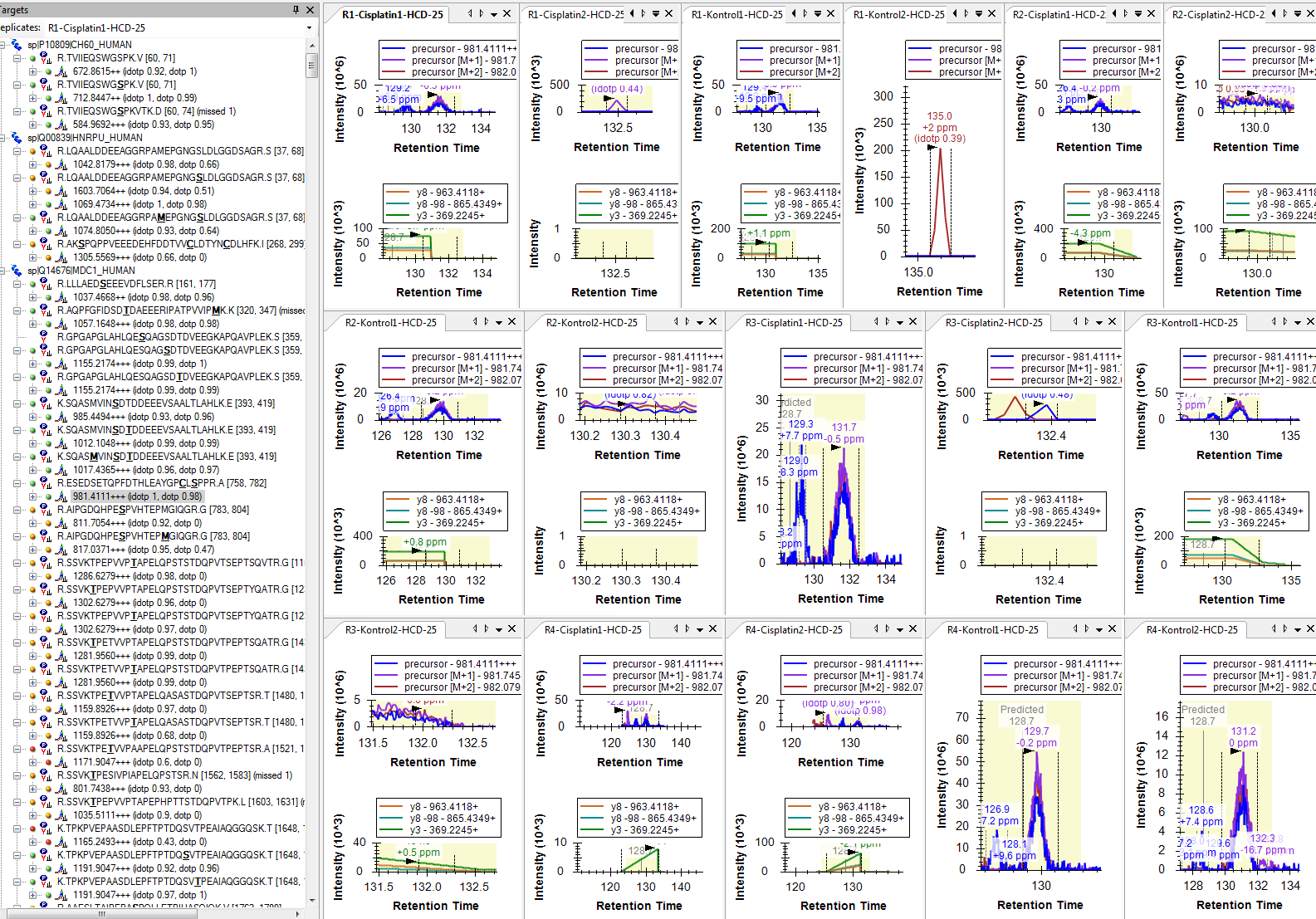
At the moment, I am just trying to identify a list of interesting peptides from my DIA run for the next PRM run. Which I check one by one, I deleted all the red node peptides, and mostly yellow node peptides by inspecting both chromagrams for precursors and products. However, there are lots of weird-looking products in the chromatogram. You can take a look at the attached picture. I don't know what is it and don't know how to explain it. Because I see lots of these weird product ion peaks, even appear in the green node peptide. So, it confused me to choose which peptides are good to move on to PRM.
And I used HCD, so there are still neutral losses but not so intense.
Thank you,
Best,
Trung |
|
| |
|
|
 Skyline support Trung-Qex-PRM.pptx
 Weird peak looking.PNG